
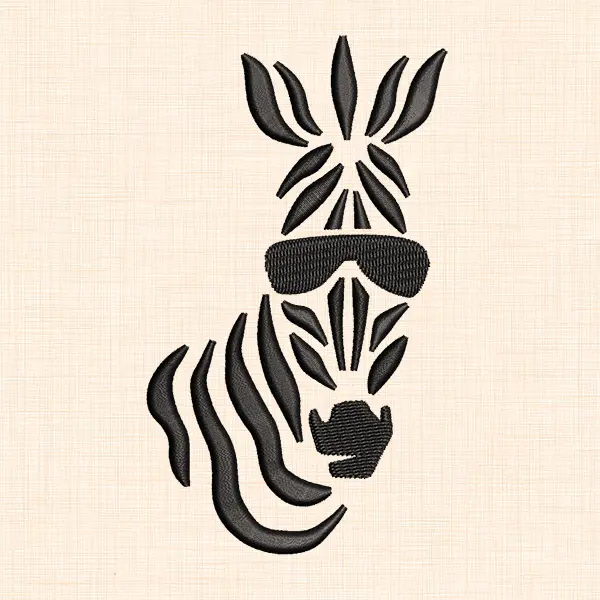

Look at this one for more than a second and something interesting happens — the stripes stop being random shapes and start reading as ears, a muzzle, a pair of sunglasses sitting right where the eyes should be. Nothing here is drawn as an outline. The face exists entirely because of where the black sections are placed and where they’re left open, which is a much harder trick to pull off than a standard filled illustration.
Read More…
A Design Built on Negative Space
Most animal face designs work by filling in a shape. This one works by doing the opposite — the background fabric itself becomes the “skin” of the zebra, visible only in the gaps between stripes. That approach keeps the stitch count surprisingly low for a design this visually complex, since there’s far less solid fill than a typical realistic animal portrait would need.
The sunglasses detail is what pushes this from “cool zebra art” into genuinely fun territory — it gives the design a bit of attitude that a straightforward wildlife portrait wouldn’t have, which opens it up to a wider range of uses than purely nature-themed decor.
Where This Tends to Get Used
Safari and jungle-themed nurseries pull double duty here, since the design reads as both artistic and playful rather than purely decorative. Beyond nursery decor, it shows up on statement tees, tote bags for animal lovers, and school or team merchandise where a zebra happens to be the mascot. Because the negative-space style photographs well, it’s also a strong pick for anyone selling finished embroidered pieces online — the contrast makes for eye-catching product photos.
Cotton and canvas hold the sharp stripe edges cleanly with a standard medium-weight stabilizer. Given how much depends on precise stripe placement here, a stable, tightly woven fabric will give better results than something loose or stretchy — save the stretchier fabrics for designs with more forgiving detail.


Reviews
There are no reviews yet.